Pakistan’s Language Issues
An overview of language issues in Pakistan on the occasion of World Mother Language Day on Feb. 21

By Nasir Aijaz
The AsiaN Representative
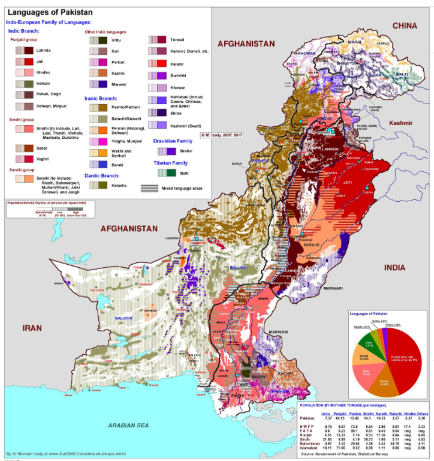
ISLAMABAD: The linguistic landscape of Pakistan is a complex tapestry woven with threads of deep cultural pride and occasional political friction. While the country is home to over 70 languages, the tension between the “National Language” (Urdu), the “Official Language” (English), and the “Regional Languages” (Punjabi, Sindhi, Pashto, Balochi, and Saraiki) has been a defining feature of its state-to-state relations since 1947.
The roots of Pakistan’s language issues trace back to the pre-partition era. Urdu was championed by the Muslim League as a symbol of Muslim identity in British India. After independence, Muhammad Ali Jinnah, Father of Nation and the 1st Governor General of the newly created country, declared in 1948 that Urdu, and only Urdu, would be the state language to ensure national unity.
This decision immediately alienated East Pakistan (now Bangladesh). Despite Bengalis making up the majority of the population, their language was denied national status.
In 1952, during the Language Movement, protests in Dhaka led to the deaths of students on February 21, a day now recognized globally as International Mother Language Day.
Though Bengali was eventually granted national status in the 1956 Constitution, the delay sowed the seeds of alienation that eventually led to the secession of East Pakistan in 1971.
Following the loss of East Pakistan, the 1973 Constitution attempted to balance national identity with regional diversity. Article 251 is the cornerstone of this policy:
*Urdu is designated as the sole national language.
*English is used for official and legal purposes until arrangements are made for Urdu to replace it.
*Provinces are permitted to promote the teaching, promotion, and use of regional languages.
Despite the constitutional provision, many ethnic groups feel that their mother tongues are being marginalized. Here is how the major languages stand today:
Punjabi is spoken by the largest percentage of people, yet it lacks a strong institutional presence in schools or government compared to Urdu.
Sindhi has the strongest institutional footing. It is taught in schools and used in provincial administration, but Urdu-Sindhi tensions remain in urban centers like Karachi.
Pashto is deeply tied to the Pakhtun identity. There is a constant push for its integration into the primary education system in Khyber Pakhtunkhaw province.
Balochi language is seen as a vital tool for preserving Baloch identity amidst political grievances; many call for it to be made a medium of instruction.
The movement for a separate Saraiki Province is heavily rooted in the recognition of Saraiki as a distinct language from Punjabi.
The debate in Pakistan isn’t just about communication; it’s about identity, economics, and power.
While Urdu is claimed to be the national symbol, English remains the gatekeeper for social mobility and high-ranking jobs. This creates a class divide.
Critics argue that by only recognizing Urdu (spoken by roughly 7% as a first language) as the national language, the state is practicing “linguistic imperialism” over the majority.
The state’s perspective is that a single national language acts as a “lingua franca,” bridging the gap between a Punjabi and a Pashtun who might not otherwise understand each other.
In recent years, there have been several bills introduced in the Senate, the upper house of the parliament, to grant “National Language” status to Punjabi, Sindhi, Pashto, and Balochi. Proponents argue that multi-lingual recognition would strengthen the federation rather than weaken it.
Language in Pakistan is not merely a tool for speech; it is a repository of history and a battleground for political recognition.