The Agrarian Paradox: Pakistan Imports Wheat Amid Record Local Production
Punjab province procured less than 500,000 tons against an initial target of 3 million tons


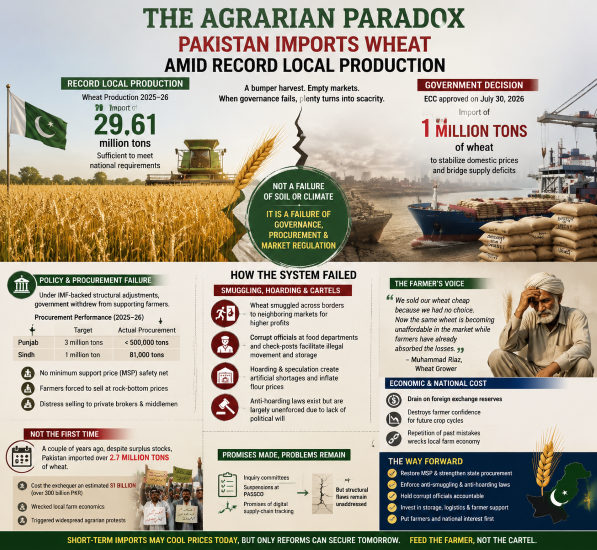
By Nasir Aijaz
The AsiaN Representative
ISLAMABAD: Despite being an agrarian economy where wheat serves as the ultimate national staple, Pakistan finds itself trapped in a recurring policy paradox, as the government has decided to import one million tons of wheat.
The Economic Coordination Committee (ECC), in its meeting on July 30, 2026, approved the urgent import of one million metric tons of wheat to stabilize domestic prices and bridge supply deficits.
However, to citizens and economists alike, the decision appears deeply flawed. According to them, the choice to import emergency wheat supplies stems from a systemic breakdown across policy, market regulation, and border enforcement.
Pakistan produced approximately 29.61 million tons of wheat in the 2025–26 harvest cycle—a bumper crop sufficient to meet national requirements. Yet, instead of curbing cross-border smuggling, dismantling hoarding cartels, and reforming corrupt food authorities, the government has chosen to drain precious foreign exchange reserves to buy wheat on the international market.
How does a country with record agricultural yield end up short on flour? Citizens and economists are right to point out that the current crisis is not a failure of climate or soil; it is a failure of governance, procurement, and market regulation.
Independent economists argue that international lenders are behind this crisis. Under economic structural adjustment frameworks with international lenders like the IMF, Pakistan shifted away from traditional minimum support price (MSP) guarantees and state procurement drives.
As a result, Punjab province procured less than 500,000 tons against an initial target of 3 million tons, while Sindh, the other primary wheat-producing province, procured barely 81,000 tons against a one-million-ton target.
When provincial food departments pulled back from buying directly from farmers at fair baseline prices, small growers were forced to sell their harvest at rock-bottom rates to private brokers and middlemen to repay debts.
The absence of aggressive state procurement left a massive vacuum that private speculators, hoarders, and smuggling networks were quick to exploit.
Historically, official minimum support prices provided a safety net for farmers and established a floor for market prices. Dismantling or delaying this mechanism left farmers vulnerable to distress selling immediately post-harvest.
Another key factor is smuggling. Wheat is routinely smuggled into neighboring regional markets where price differentials yield high profits, draining local reserves and ultimately requiring expensive international imports.
Corrupt officials in provincial food departments and at check-posts facilitate illegal movement and storage, while anti-hoarding laws remain largely unenforced due to a lack of political intervention.
“We sold our wheat cheap because we had no choice. Now the same wheat is becoming unaffordable in the market while farmers have already absorbed the losses,” Muhammad Riaz, a local wheat grower, was quoted as saying by local media.
Independent economists note that these shortages are artificial. Middlemen purchase grain cheaply directly from farmers who lack storage facilities or cash reserves, and these stocks are then withheld from the market to artificially restrict supply and inflate retail flour prices.
This situation is not unprecedented. A couple of years ago, similar policy mismanagement led to the importation of over 2.7 million tons of wheat by federal authorities despite holding surplus stocks.
That decision wiped out an estimated $1 billion (over 300 billion Pakistani rupees) from the national exchequer, wrecked local farm economics, and triggered widespread agrarian protests.
Despite official inquiry committees, suspensions at agencies like the Pakistan Agricultural Storage and Services Corporation (PASSCO), and promises of digital supply-chain tracking, structural flaws remain unaddressed.
While importing wheat offers a temporary fix for retail price spikes, it imposes severe costs on foreign exchange reserves and destroys farmer confidence for upcoming crop cycles.