Sri Lanka’s Strategic Role in the Indo-Pacific Amid Japan’s New Dry Dock Expansion
Sri Lanka's ports are becoming vital to Japan's long-term strategic objectives


By Leo Nirosha Darshan
COLOMBO: The Indo-Pacific region is currently reaching a historical turning point along the maritime trade routes that serve as the nervous system of the global economy, as well as in the security environment surrounding them.
The rise of Eastern naval superpowers and the lag in traditional global naval infrastructure have forced the creation of new alliances and strategies in international politics. In this context, the announcement by Japan—the world’s third-largest shipbuilding nation—that it plans to build a new large, modern dry dock by 2035 through its ‘Namura Shipbuilding’ company has sparked major discussion in global naval security and commercial circles.
At a time when the United States is struggling to deal with deficiencies in its naval maintenance and shipbuilding capacity, it views this expansion by its close ally Japan with high expectations.
However, the stark industrial realities behind this infrastructure expansion, alongside the pivotal role played by Sri Lanka’s ports—positioned at the heart of the Indian Ocean—within the Japanese and international maritime framework, are subjects that require deep analysis.
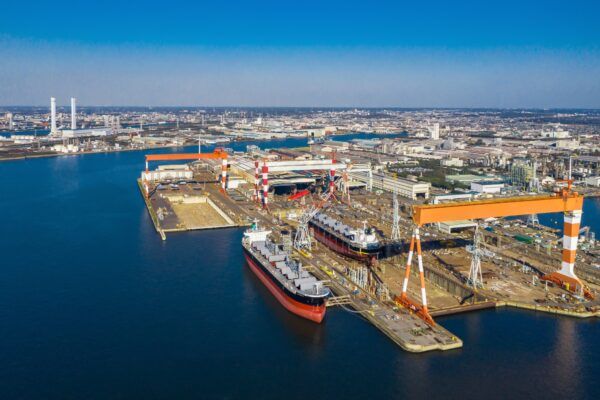
Located in Imari Bay in the northwestern part of Kyushu in Japan’s Saga Prefecture, this proposed dry dock will be the first major dry dock built in Japan since 2017. Once fully completed, it has been announced that the dock will primarily be used to construct massive commercial vessels carrying Liquefied Natural Gas (LNG).
This project forms a key part of a comprehensive national economic recovery plan undertaken jointly by the Japanese government and its domestic industry.
Japanese Prime Minister Takaichi Sanae officially declared the shipbuilding sector as one of seventeen key industries determining the country’s economic growth. Following this, Japan set a target to double its annual shipbuilding capacity to 18 million gross tons, backed by a massive public-private fund valued at one trillion yen.
During the post-World War II era, the shipbuilding industry served as a massive pillar of Japan’s industrialization and economic growth. Over recent decades, however, Japan lost market share due to intense competition from China and South Korea.
Current investments are viewed as an effort to reclaim that lost prominence. On the other hand, the United States is attempting to counter China’s rapidly expanding naval strength and dominance in the global commercial shipping market. Yet, America’s own warship yards are hamstrung by improper maintenance, severe delays, and workforce shortages.
Because U.S. commercial shipyards produce vessels at costs four times higher than international market prices, they cannot compete globally beyond their domestic market.
Against this backdrop, serious deliberations were held at U.S.-Japan defense summits to expand repair operations for U.S. warships beyond military bases in Japan to Japanese commercial shipyards.
Using Japanese yards instead of sending U.S. warships across the Pacific Ocean to Guam or the U.S. mainland for maintenance would save roughly 17 days of travel time. This would enhance the operational readiness of the U.S. Navy while offering substantial commercial opportunities for Japanese firms.
However, a major bottleneck to this defense cooperation has emerged: the current capacity shortage at Japanese yards. Namura’s existing Imari facility is already operating at full capacity, overflowing with commercial ship production.
Tokyo’s industrial planning reports also identify capacity constraints as their primary challenge. Because production time at the new dry dock scheduled for 2035 is already booked for commercial LNG ships, there will be no space allocated for the U.S. Navy.
Furthermore, converting a yard built for commercial vessels into a facility for maintaining military ships is no simple task. Warship maintenance demands specially trained personnel, an understanding of U.S. security protocols, and security clearances.
In addition, Japan faces a nationwide shortage of approximately 12,000 workers in the shipbuilding sector. Thus, it is clear that military agreements and political will alone cannot realize genuine defense cooperation between the two nations; supply chain and infrastructure limits ultimately dictate the outcome.
Strategic Connectivity of Sri Lankan Ports on the East-West Maritime Route
Amid the infrastructure and capacity constraints Japan faces in the Pacific region, Sri Lanka’s ports—situated at the midpoint of global trade routes in the Indian Ocean—are becoming vital to Japan’s long-term strategic objectives.
Crude oil and natural gas imported by Japan from Middle Eastern nations to meet its energy needs reach Japanese shores via the Indian Ocean. Therefore, Japan’s engagement with Sri Lankan ports plays a critical role in ensuring the security of the Strait of Malacca and Indian Ocean maritime trade routes.
Specifically, Sri Lanka’s Colombo Port, the natural harbor at Trincomalee, and Hambantota Port are all strategically located along the international sea lanes connecting East Asia to Western nations. The Port of Colombo serves as South Asia’s largest transshipment hub.
The involvement of Japanese and Indian companies in developing the West Container Terminal (WCT) at the Colombo Port is viewed as a calculated effort to balance China’s influence. As Japan’s planned LNG vessels travel through the Indian Ocean, Colombo Port has the capability to serve as a key refueling and technical support hub for them.
Regional Security and the Future of the Global Supply Chain
Japan’s new dry dock expansion is not merely the infrastructure growth of an individual company; it represents an emerging new equilibrium in international maritime security. As the United States has lost key infrastructure required for its own naval maintenance, it finds itself forced to rely on East Asian allies.
However, Japan’s current industrial situation, capacity limits, and labor shortages make it clear that these expectations cannot provide an immediate solution. Under these circumstances, keeping Indian Ocean trade routes secure is vital not only for Japan but for the entire global economy.
The development of Sri Lankan ports plays a primary role in securing Japan’s maritime supply chain. In the event of increased Chinese naval incursions, the presence of Japan and its allies at Sri Lankan ports helps establish a strategic balance in the region.
In summary, Japan’s effort to expand its dry docks by 2035 is a strategic move aimed at restructuring its domestic economy and preserving its standing in maritime commerce.
Nonetheless, Japan’s current capacity shortages highlight the operational limits of the U.S. alliance in the Pacific Ocean. At the same time, deep engagement with Sri Lanka’s Colombo and Trincomalee ports in the Indian Ocean will remain the primary factor enabling Japan to operate its commercial fleet safely and maintain an uninterrupted global supply chain.