From Political Changes to Economic Growth, from Wars to Disasters: Asia’s Defining Year 2025 (I)

The year 2025 in Asia was shaped by impressive economic performances, historic turning points, lingering tensions between neighbors, high-stakes elections, waves of protest, the change of governments, cautious diplomatic breakthroughs among certain states, and relentless natural disasters with deep scars for peoples and countries.
THE AsiaN, founded on Asia Journalist Association’s network of journalists, is highlighting through articles written by its members the major issues that defined 2025 across Asia’s regions and countries. – Editor’s note”
Timor-Leste Steps Forward as ASEAN’s Bridge in the Era of US–China Rivalry
By Ivan Lim,
Former AJA President, Singapore
From the Periphery to the Center: Timor-Leste’s Strategic Rise
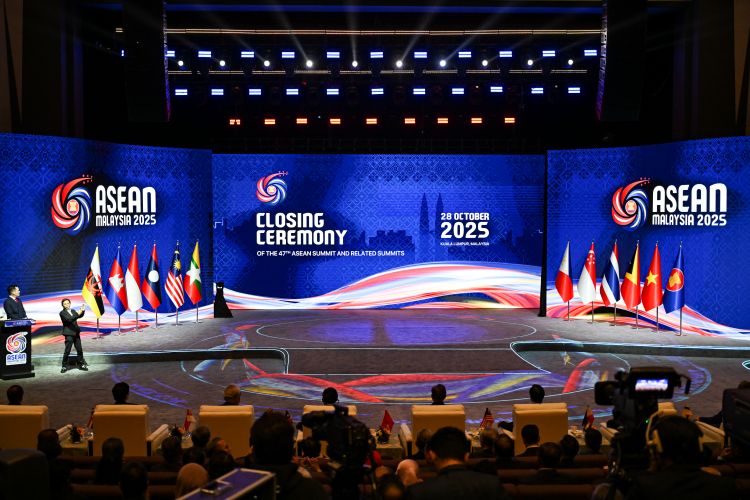
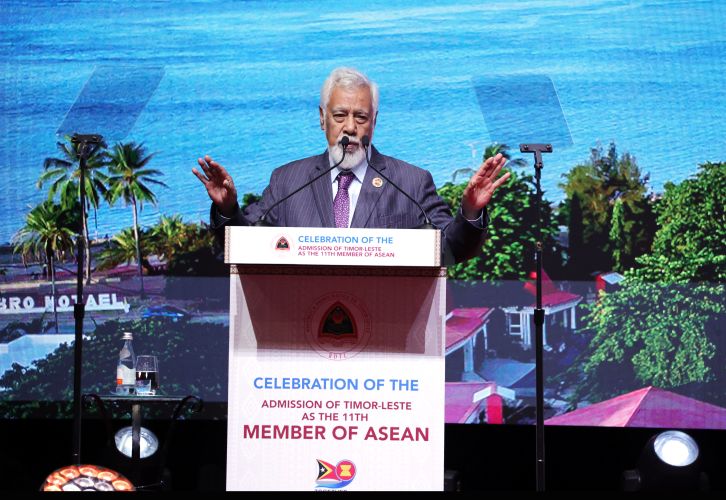
Timor-Leste is open for business, its president Dr Jose Ramos-Horta declared as the island state joined ASEAN on October 28 as its 11th member. Indeed, its vast oil and gas reserves, coupled with rich fisheries and natural harbours, will be an economic boon to ASEAN. But these assets will also inject a new dynamic into ASEAN’s efforts to navigate the turbulence of superpower rivalry.
Early Courtship by Washington and Beijing
Both the United States and China have shown their presence in the maritime nation with naval visits, including in 2017 by China’s hospital ship, *Peace Ark*. A US aircraft carrier has also made port calls and conducted training exercises in Timorese territorial waters.
For its part, the young nation of 1.41 million people is keen to attract more foreign investment for its vast gas fields in the Timor Sea, such as the Greater Sunrise and Troubadour wells. The state-owned Timor Gap firm has joint ventures with Australian and Japanese companies.
Timor-Leste has prioritised infrastructure development, opening the way for ASEAN states and China to undertake business projects. Singapore, for one, is keen on its capability-building programmes.
However, Dili, the capital, which sees China as an economic competitor to the US, is cautious over a Chinese offer to build radar arrays for monitoring fishing fleets.
Ramos-Horta’s Diplomatic Vision: ASEAN as a Bridge-Builder
As a new member of the regional bloc, Timor-Leste is viewing Chinese and American overtures in line with its perception of ASEAN as a “bridge-builder between conflicting rivalries of the superpowers.”
Dr Ramos-Horta is optimistic that the US and China will back ASEAN’s efforts to bring about peace in the region through diplomacy and dialogue.
On the contentious issue of the South China Sea, where Beijing’s “nine-dash line” historical claims overlap with the exclusive economic zones of several ASEAN states, the Nobel laureate has taken an enlightened stance.
“No claimant state will back down,” he said at a press interview. “The solution is to freeze claims and make the South China Sea a sea of peace and partnership.” He stressed: “Allow only traditional fishing and stop overfishing. This will also prevent clashes between fleets.”
Rising South China Sea Tensions and ASEAN’s Calculations
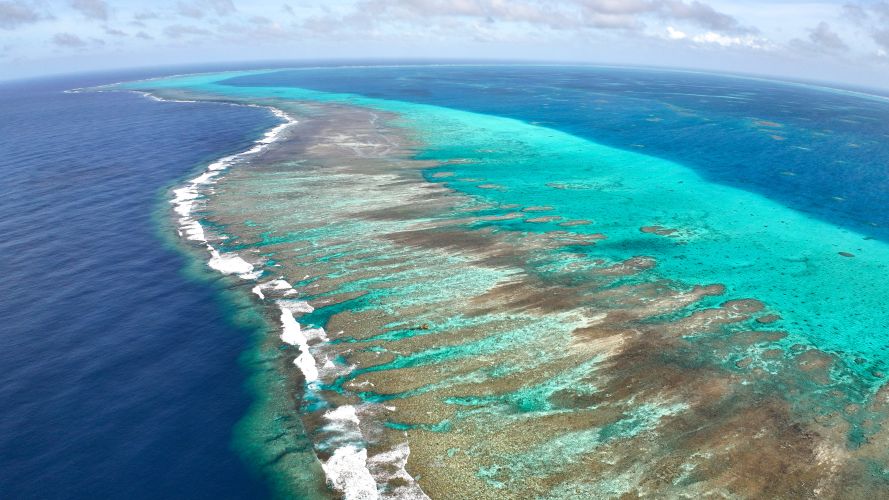
Formulating a code of conduct for resolving maritime disputes between ASEAN claimant states and China has been decades in the making. ASEAN’s current chair Malaysia has struck a note of urgency with Beijing on the code in the wake of confrontations in the disputed Spratly Islands involving Chinese coast guard ships and Philippine supply vessels and fishing boats. Incidents at Second Thomas Shoal and Scarborough Shoal included Chinese coast guard ships training water cannons on Philippine boats and collisions at sea.
Given its friction with China, the Philippines will be watched closely on how, as the next ASEAN chair, it will handle the South China Sea issue. Analysts note that it is a treaty ally of the United States and maintains close ties with East Timor, a fellow Catholic nation. But any unilateral moves would be tempered by ASEAN’s norms of neutrality.
At the same time, Philippine President Ferdinand Marcos Jr. said Manila would “champion peace and stability through dialogue” as well as “adhere to international law and enhanced cooperation on traditional and non-traditional security issues.” Indeed, he vowed, as ASEAN’s chief interlocutor in 2026, to push for the adoption of the ASEAN–China code of conduct for the peaceful resolution of South China Sea disputes.
Tariff Wars and ASEAN’s Balancing Act
The “liberation day” tariffs imposed on April 2 by President Donald Trump have tested ASEAN’s solidarity as member states negotiated separately with Washington according to bilateral trade balances and their impact on economic growth.
In efforts to win concessionary tariff rates, Malaysian Prime Minister Anwar Ibrahim praised Mr Trump, guest of honour at the 47th ASEAN Summit in Kuala Lumpur, as a trouble-shooter who helped end the Thai–Cambodian conflict and the Israel–Hamas war, thereby boosting his chances of winning the Nobel Peace Prize in 2006. Mr Anwar clinched a lower 19 per cent tariff in a reciprocal trade deal that gives Washington access to Malaysia’s rare earth resources. Controversially, the pact contains clauses that tie Kuala Lumpur to comply with US controls and restrictions on sensitive technology products and sanctions against third countries, including China.
This apparent tilt towards the US has prompted China to raise its misgivings with Kuala Lumpur and Cambodia on access for its exports and the supply of critical technologies arising from the US trade deal.
Malaysia is working on a memorandum of understanding to address Beijing’s concerns. Mr Anwar also highlighted ASEAN’s upgrade of a free trade deal with China — a day after Mr Trump left the ASEAN summit — as a “diplomatic balancing act.”
Notwithstanding this, Mr Trump’s presence at the ASEAN summit won him plaudits and swung sentiments towards America’s side as he lauded the “spectacular” ASEAN leaders, declaring that “whatever you touch turns to gold” and that the US would be a “strong friend and partner for generations to come” in a free, open and thriving Indo-Pacific.
Indonesia, Singapore and ASEAN’s Collective Strategy
Adding to the momentum of a swing towards Washington, Indonesian President Prabowo Subianto has separately negotiated a 19 per cent reciprocal tariff rate in a trade package that commits Jakarta to purchase 50 Boeing jets and US energy and farm products. But the deal excludes the “poison pill” that binds Malaysia and Cambodia to US coercive clauses targeted at China.
Mr Prabowo has established good rapport with Mr Trump. A former general, he was the only Southeast Asian leader invited to the US-led Gaza peace summit in Egypt on Oct 13 and has pledged to deploy 20,000 Indonesian personnel for future peacekeeping efforts. Still, Indonesia, as the largest state in ASEAN, has shown the way in maintaining an even keel amid the intense jostling for influence between the US and China.
As the only ASEAN member with an existing free trade agreement with the US, Singapore has a 10 per cent baseline tariff. Singapore Prime Minister Lawrence Wong welcomed Mr Trump’s latest pledge to stand “100 per cent” with ASEAN and act as a partner and friend to underwrite long-term peace, security and prosperity in the Indo-Pacific region.
The US Navy has had access to facilities at the RSS Singapura–Changi naval base since 1990 to ensure a balance of power in the South China Sea vis-à-vis a rising and increasingly assertive China.
This is to “uphold the rule of international law in the global order, so that might does not equal right,” according to Defence Minister Ng Eng Hen.
The city state does not take sides as such. Rather, it acts according to principles such as an inclusive, open and connected global security and economic architecture.
However, the increasingly protectionist trade policies unleashed by Mr Trump have led Singapore, an open and free-enterprise economy, to push for more open and fair trade deals with other countries. One such initiative is the 13-member Future of Investment and Trade Partnership. Earlier, ASEAN also upgraded its free trade pact with China, covering new sectors such as the digital and green economies as well as supply chain connectivity, among others.
With their economies at different stages of development, ASEAN states may be seen individually as having diverse responses towards the contending superpowers seeking to woo them. Collectively, however, ASEAN has held the line on portraying unity within diversity, now with new member Timor-Leste on board.